Last year we performed a pilot forHWBPto investigate if our AI-driven Reference Class Forecasting engine (RCF-AI) could help improve the current reference framework applied for dike cost estimations in the Netherlands.
HWBP’s reference framework is intended as a guidance to determine realistic cost ranges at an early stage, based on complexity. It thus supports discussions about expected project costs and risk reserves, while maintaining the bottom-up estimation process.
Project context
With ca. 1400 kilometers of dike reinforcements the alliance of HWBP and Waterschappen has the amazing task to protect the Netherlands against flood risk. Reliable cost estimates are important to properly substantiate design choices and investment decisions.
We apply AI by combining internal data from 83 projects with geo-indicators and GenAI-extracted data. We investigate to what extent this leads to more accurate estimates and a smaller margin of uncertainty.
Traditional versus AI approach

The existing reference framework uses four complexity classes with static bandwidths for costs per kilometer. The AI method uses a wide range of data sources to obtain context-dependent and dynamic bandwidths.
Furthermore, the AI method makes the inflation correction more specific. While the current reference framework applies a generic inflation correction, the AI inflation correction is tailored to the relevant type of dike (section).
Features used by AI
The project focused on estimating realisation costs for dike reinforcements and combined internal project data with public external data.
For this pilot we used features from multiple sources. In addition to internal project characteristics (e.g., timing and scope of the project), we use GenAI to derive additional public characteristics (such as dike type and failure mechanisms) and enrich a subset of projects with geo-indicators (such as population density, flood risk, and proximity to Natura 2000 areas).

AI Methodology

A data processing pipeline aggregated information from all data sources. Our RCF-AI model was then deployed to evaluate the most relevant features.
A different algorithm is used to identify the ten most comparable projects. Our models currently outperform initial human expert estimates with a 50% smaller modelerror on testable cases.
Dashboard Output
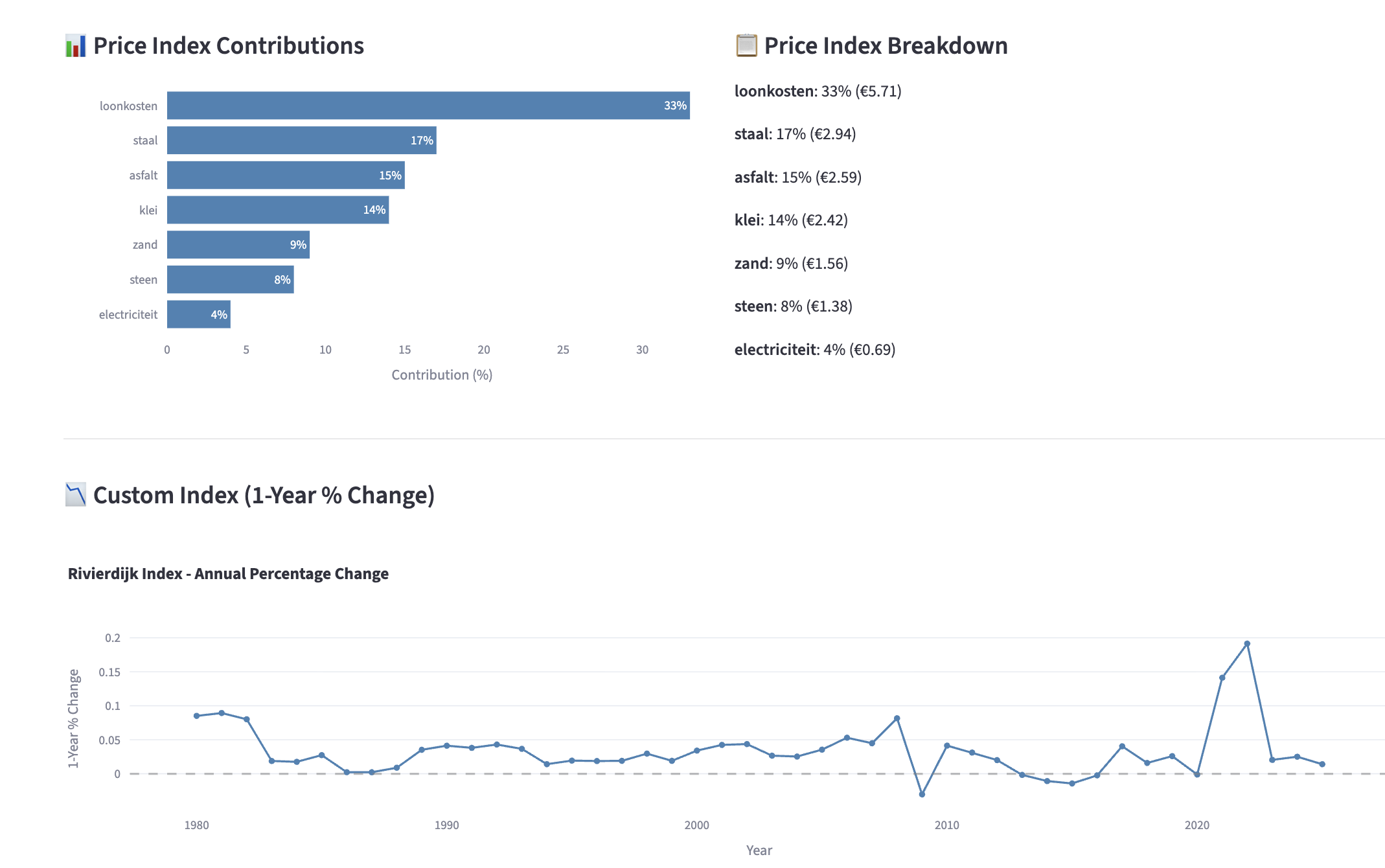
The cost estimations for both completed, ongoing and new projects are conveniently shown through a web-based dashboard, and include the following information:
- Key drivers
- Custom Dike Price Index based on material weights
- Expected costs per kilometer for ongoing projects
- The ten most comparable projects
- Quantification of the uncertainty surrounding the expected costs

Value & Roadmap

This pilot has shown that expanding the reference framework with a context and AI-driven methodology supports both faster, more reliable and more transparent decision-making for dike cost estimations in the Netherlands.
The future roadmap focuses on further model improvements, model validations, scaling up dashboard functionality, and adding a module for potential (VTW) realisation risks.
Read more about the RCF-AI tool, our presentation at the HWBP dijkwerkersdag 2026, the methodology, validation and scope: