

Better estimates through empirically validated predictions
Improve estimates of project costs, investment value and financial risk through context-dependent risk distributions.
Our method automatically selects the most relevant historical cases based on their predictive value and provides insight into the key predictive factors. Predictive performance has been tested through rigorous out-of-sample validation.
Applications: infrastructure, real estate and urban development, energy transition, public investments, and macro-financial risks
An independent, evidence-based perspective.




Empirically validated forecasts across three domains
Dike reinforcements
50%
better than projectteam estimation
lower prediction error in early P50/P80 estimates; out-of-sample validated.
Land prices
38%
lower downside-risk estimation error
Out-of-sample validated on holdout-set of 20 year
Interest rates
68%
lower downside-risk estimation error
Validated in backtests since 1950, while preserving coverage
We measure forecasting performance on data that was not used to develop the models.
Early estimates and risk assessments often lack context
Many early estimates and risk assessments still rely heavily on internal assumptions, static benchmarks or limited historical comparison. That makes it harder to see downside risk clearly, especially when project context and macroeconomic conditions matter.
Some domains where we add value
Infrastructure
Use top-down, feature-based Reference Class Forecasting alongside detailed bottom-up engineering estimates to assess whether expected project costs are consistent with empirical outcomes
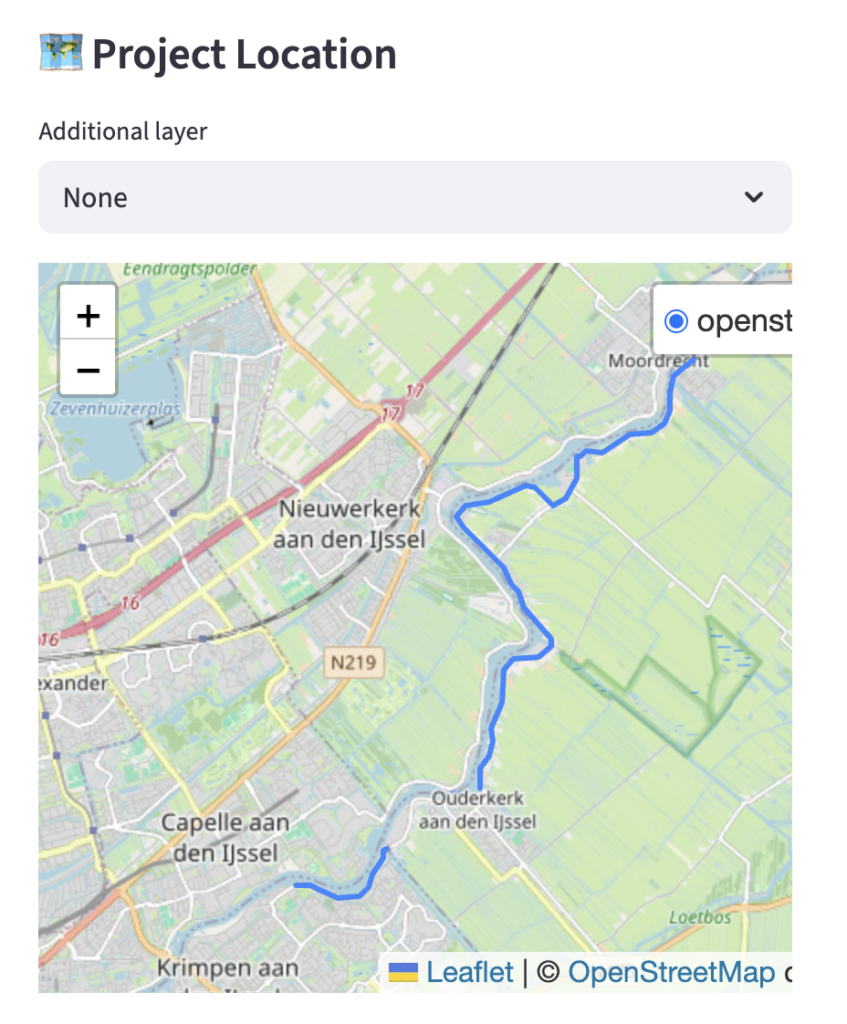
Dike reinforcement cost estimation
Read how we apply RCF-AI, or AI-enhanced Reference Class Forecasting, to dike reinforcement projects.
This method helps to obtain better grounded and context dependent cost estimates.
Municipalities and real estate developers
Improve estimates of the future value and financial risks of land development and real estate projects through well-substantiated scenario analyses.
Land Development Risk
Discover how a municipalities uses context-specific scenario analysis to better assess and substantiate financial risks for reporting under the ‘Besluit begroting en verantwoording’ (BBV).


Project Risk
Discover how municipalities can better assess investment and operating risks associated with public facilities, such as an outdoor swimming pool or an art museum.
Financial institutions
Discover how interest rate and inflation risk models can be improved using context-dependent risk profiles that adapt to changing macroeconomic conditions.

Model Validation
Four articles about interest rate risk models:
- Solvency II: insurance sector
- Wtp: pension funds
- BASE method: statistical
- REGIME-BASED: context dependent
- Comparison of model performance
Loan Portfolio Interest Risk
Learn how to obtain a risk estimate for a loan portfolio that is to be refinanced using the so called ‘Value at Risk’ method.

Products and tools for decision support
Explore our products and services for context-dependent risk assessment, including AI/ML-enhanced Reference Class Forecasting, risk tools and decision support grounded in transparent validation and observed performance.
Our approach
AI-driven Reference Class Forecasting
Our models combine reference class evidence, advanced machine learning algorithms, project-, location- and macro economic context to reveal the key drivers of risk and value. This helps us to create a validated, modern variant of Reference Class Forecasting.
We call this method Predictive Reference Class Retrieval (Predictive RCR). It enables us to identify both the drivers that matter and the dynamic, context-specific reference classes that are most relevant for the intended purpose, based on demonstrated predictive relevance.
As a result, the relevant historical evidence can depend entirely on the context; whether it involves comparable infrastructure projects, locations, or historical economic regimes. We make transparent both which reference observations and which contextual factors and underlying drivers determine the forecast, while rigorous out-of-sample validation tests whether these relationships also hold beyond the data used to develop the models.
- Context-specific reference class evidence
- AI/ML-enhanced forecasting
- Rigorous out-of-sample validation
- Explainable AI and visible drivers
- Empirically grounded forecasts and risk assessments
From assumptions to defensible risk decisions
This helps organisations move beyond subjective assumptions and produce more transparent, more robust and more defensible risk assessments that reflect project and macroeconomic context.
We publish model documentation and validation material to clarify assumptions, limitations and observed performance. How we validate risk forecasts
More transparent
See which comparable cases, macro conditions and drivers shape the risk outcome.
Enabled by explainable AI and reference-class evidence.
More robust
Ground estimates and risk assessments in quantitative modelling and out-of-sample validation.
Built to perform beyond in-sample fit.
More defensible
Support high-stakes decisions with explainable outputs, documented assumptions and observed performance.
Designed for governance, challenge and scrutiny.
Out-of-sample validation
Explainable AI
Observed performance
Transparent documentation
Founders
Insights

Reference Class Forecasting
Learn about the basics of reference class forecasting and its role in predicting expectation and risks. Discover how it improves risk forecasts and project success.
Risk Aversion
Discover the psychology of loss and risk aversion in decision-making. Explore how humans avoid negative impacts and uncertainty.


Trustworthy AI: why predictive power alone is not enough
Read why trustworthy AI is essential for decision support and how validation, transparency, and reproducibility contribute to it.
Land price risk in context
We analyse historical land prices in the Netherlands and use a context-driven regime-based model to forecast the risk.


Interest Rate Risk
Explore the main factors that need to be considered when calculating the refinancing costs.